How to Win on YouTube in 2026
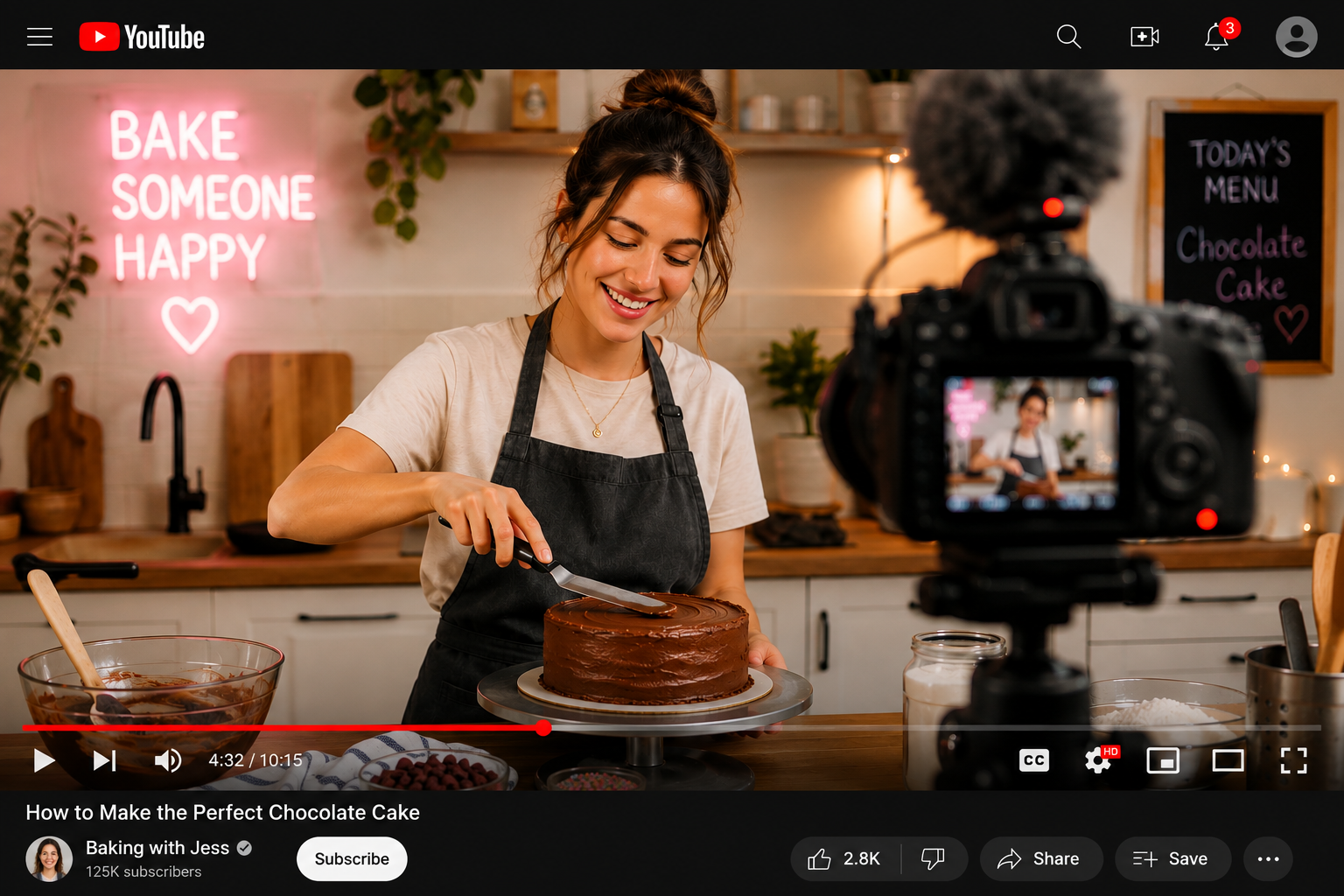
Image of a female YouTube baking influencer spreading chocolate frosting on a cake
Social media marketing often hinges on Facebook, Instagram, LinkedIn and increasingly TikTok. But there’s another platform that deserves priority in your marketing strategy: YouTube.
YouTube has more than 3 BILLION searches per month nowadays, ranking it second only to Google as the go-to for search.
What began as a place to watch videos, YouTube now has a super sophisticated recommendation system designed to connect viewers with videos they are likely to watch and enjoy, making the platform an important discovery channel for businesses that can create useful, relevant content. And according to a recent analysis by Metricool, views per video increased substantially in its study of more than 7 million videos from over 82,000 YouTube accounts.
The opportunity for smaller businesses is particularly interesting because succeeding on YouTube isn’t necessarily about having the largest advertising budget or the biggest production team. It’s about understanding your audience and consistently producing content they actually are interested in and want to watch.
Here are some ways to win on YouTube in 2026.
Stop Trying to “Beat the Algorithm”
One of the biggest misconceptions about YouTube is that businesses need to figure out some secret formula for manipulating the algorithm.
That’s the wrong way to think about it.
YouTube itself says its recommendation system has two primary goals: helping viewers find videos they want to watch and maximizing long-term viewer satisfaction. The system looks at personalization signals as well as how viewers respond when particular content is offered to them.
In other words: Don’t create videos for the algorithm. Create videos for your customers.
For a small or medium-sized business, that means starting with the questions your customers are already asking.
A financial advisor might create videos answering questions about retirement planning or tax-advantaged strategies for growing your wealth before you retire.
A custom luxury homebuilder could explain the differences in quality between construction materials, the best building techniques, or walk viewers through a 3D virtual tour of the homebuilding process.
A restaurant could publish behind-the-scenes cooking videos, with tips about their technique on sauces or the perfect sear for a steak.
A law firm could answer frequently asked legal questions, explain your legal rights when you have an encounter with law enforcement, or share the finer points of an employee’s rights in the workplace such as getting paid for mandatory overtime.
A manufacturer could demonstrate how its products are made or used, and the features of a new piece of equipment they just invested in.
The best topic is often not “What do we want to tell people?” but “What do our customers want to know?”
Focus on Clicks, Watch Time & Engagement
Several signals can help YouTube understand how viewers respond to content, including clicks, watch time and engagement. YouTube’s own guidance similarly emphasizes whether viewers choose to watch content and whether they enjoy it.
That has practical implications for businesses.
First, people need to click the video.
This is why your title and thumbnail therefore matter enormously.
Instead of: “Smith & Co. Retirement Planning Video #4”
Consider: “5 Retirement Mistakes That Could Cost You Thousands”
The second title tells viewers immediately why they should care, and creates a sense of FOMO — Fear of Missing Out, and doing the wrong thing.
Once someone clicks, however, you have another important job: Keep them watching.
Avoid a lengthy introduction about your firm’s history. Get to the useful information quickly to keep them engaged.
Tell viewers what they are going to learn, and then deliver it quickly.
YouTube SEO Still Matters
YouTube recommendations are highly personalized, but search remains an important way for people to discover videos for other companies or brands that might interest them. Businesses should apply some of the same thinking they use for website SEO to their YouTube content.
Start by researching what potential customers are searching for. Google’s Keyword Planner can help identify keywords related to your products or services and provide information about search trends and estimated search activity.
Then incorporate relevant terms naturally into your video’s title and description.
For example, an Atlanta HVAC company would generally be better served by a useful, specific topic such as:
“How Often Should You Replace an HVAC Filter?”
Than something generic like:
“Our Latest HVAC Tips.”
Match your expertise with questions people are already asking.
Remember Your Thumbnail Is an Ad for Your Video
Even a terrific video won’t accomplish much if nobody clicks it.
Think of the thumbnail as a miniature advertisement for your video. It needs to communicate an idea almost instantly.
Aim for readable, attention-grabbing thumbnails that accurately represent the video’s content. Consistency can also help viewers begin recognizing your content.
You don’t need elaborate graphic design. A clear image, a recognizable person or product and a few words communicating the video’s benefit can be enough.
Most importantly, don’t promise something the video doesn’t deliver. Winning a click but immediately losing the viewer isn’t a successful strategy.
Use Shorts to Reach New Audiences
Don’t assume every YouTube video needs to be a five- or ten-minute professional grade production.
YouTube Shorts can now run up to three minutes for qualifying square or vertical videos, giving businesses considerably more flexibility for short-form storytelling.
That creates plenty of opportunities:
Answer one frequently asked customer question
Demonstrate a product
Share a quick tip
Show a before-and-after transformation
Introduce a new employee, or feature an employee with expertise
Explain an industry term
Demystify something people often misunderstand or get wrong
Pull an interesting moment from a longer video
Take viewers behind the scenes of your business
Shorts can be relatively inexpensive to produce, making them especially useful for businesses without large marketing & PR departments. It’s OK if it looks casually made and recorded with a phone, but aim for decent lighting and good resolution so it’s pleasant to watch.
It’s not either-or. Shorts can complement longer videos rather than replace them. You might publish a detailed five-minute explainer and then create several short videos based on individual ideas from that longer piece.
Don’t Just Publish—Build a Community
YouTube should not be treated as another broadcasting channel where your business posts something and walks away.
Comments and audience interactions give you valuable information about what customers care about. Respond to comments, ask viewers questions, and use YouTube’s community features to encourage interaction and cultivate a community.
This is particularly valuable for smaller businesses because it can turn video into a two-way conversation.
A question in the comments might even become the subject of your next video.
Consistency Beats Outsized Ambition & Lack of Follow-Through
You do not need to publish every day. In fact, you shouldn’t. Maybe not even once a week all the time.
For many small and medium-sized businesses, trying to produce too much content leads to rushed videos, exhausted employees, burnout, disengagement among leadership, and eventually an abandoned YouTube channel.
Instead, choose a realistic schedule that you can consistently deliver.
Create an editorial calendar with themes, topics, deliverable dates, interviews you need to record with leaders or employees, post-production schedules (if needed), and a plan for when you will publish videos.
One strong video every two weeks may be considerably more valuable than posting mediocre videos once or twice a week. Maintain consistency without sacrificing quality.
More importantly, think long term. A thoughtfully curated YouTube channel can continue introducing people to your company for many years.
Measure What Actually Matters
Finally, don’t judge success entirely by subscriber counts or whether a video “goes viral.”
Pay attention to how viewers actually behave.
YouTube provides analytics around content performance and audience behavior, while platforms such as Metricool can provide additional analysis across videos and social channels.
Look at which topics attracted viewers, which titles generated clicks, how long people watched, where viewers stopped watching and which videos generated meaningful engagement like comments, a phone call, an email, a meeting, or a new lead.
Then use those insights to decide what to create next.
The Bottom Line for Small Businesses
YouTube doesn’t have to mean expensive cameras, elaborate studios, professional production, or chasing millions of views.
For most small and medium-sized businesses, the objective should be much simpler: Be genuinely useful to the people most likely to become your customers.
Answer their questions. Demonstrate your expertise. Create compelling titles and thumbnails. Get to the point quickly. Experiment with both Shorts and longer videos. Engage with the people who respond.
Then study the data and continually improve.
Instead of chasing an algorithm, let your strategy be informed by YouTube’s recommendation system and focus on creating content people are genuinely interested in.