The SEO & AIO Playbook You Need for 2026
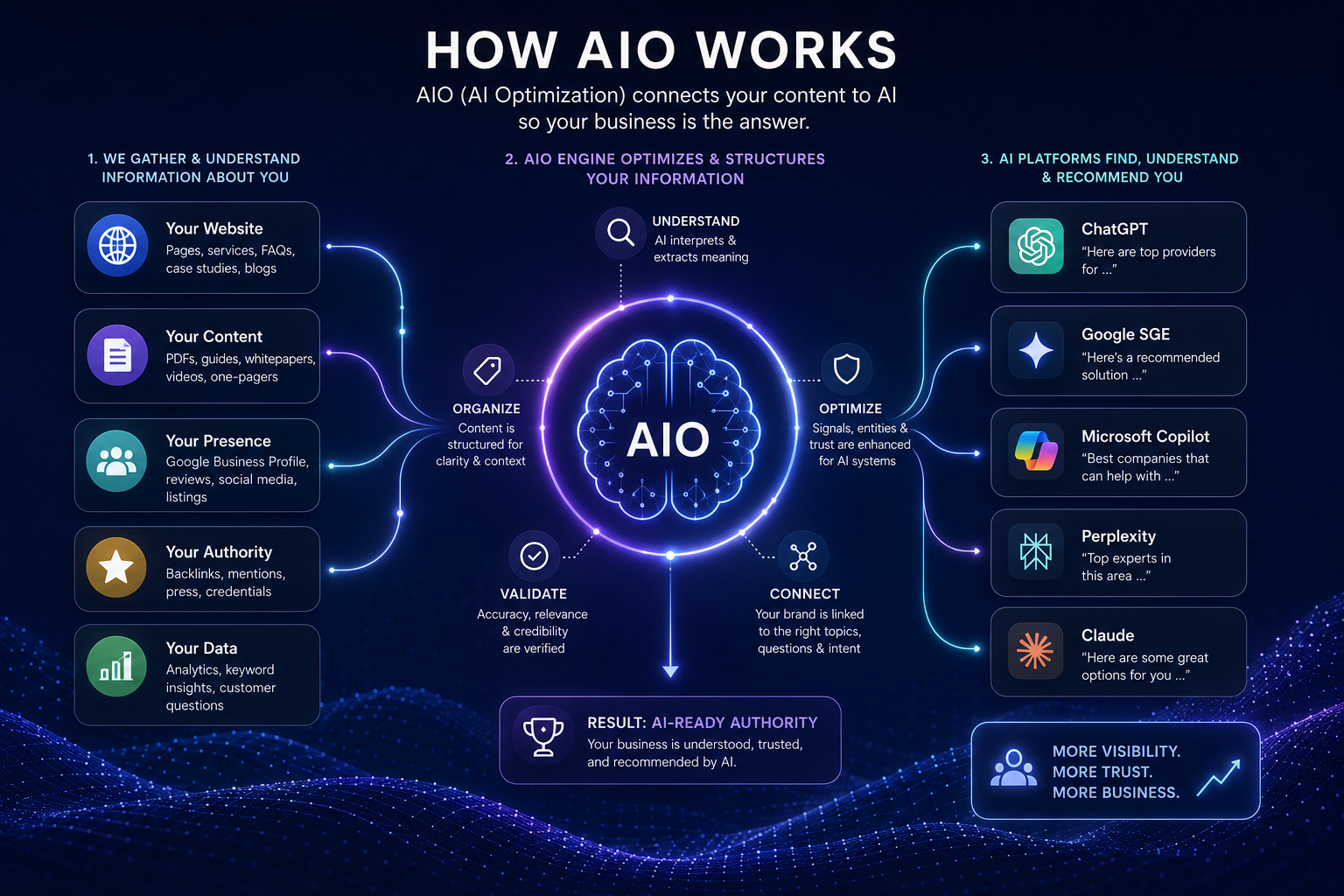
Illustration showing how SEO and AIO work.
For nearly two decades, digital marketing revolved around one goal: ranking #1 on Google.
While that still matters, the way people discover businesses has changed dramatically with the rise of AI and AIO.
Today, potential customers don't just type keywords into Google — they ask questions in Google's AI Overviews, ChatGPT, Gemini, Perplexity, Claude, and voice assistants like Siri and Alexa.
This shift means success is no longer anchored to appearing in search results — it's about becoming a trusted source AI systems choose to reference.
The good news? Everything you've already learned and mastered about SEO is very much relevant. In fact, Google has made it clear that optimizing for AI search is fundamentally still SEO, not an entirely separate discipline.
The upshot: Businesses that win will combine strong traditional SEO with content designed for AI-powered overviews and search experiences, or AIO.
What is SEO?
Search Engine Optimization (SEO) improves your website so search engines understand your content and rank it highly when someone searches for relevant topics. Traditional SEO focuses on:
Creating helpful, high-quality content
Using relevant keywords naturally
Optimizing page speed and mobile usability
Earning quality backlinks
Organizing your website logically
Maintaining strong technical performance
These fundamentals remain just as important today as they were five years ago.
What is AIO?
One of the biggest buzzwords in marketing today is AIO, which often refers to AI Overviews — the AI-generated summaries that appear at the top of many Google searches. Others use AIO more broadly to mean "AI Optimization," or optimizing your online presence so AI tools understand and recommend your business.
Regardless of the terminology, the objective is simple: Become the business that AI trusts enough to cite.
Instead of merely asking: "Can I rank #1?"
Businesses should also ask: "Will AI recommend me when someone asks about products or services that I happen to offer?"
That requires a broader approach than traditional keyword optimization.
The New Reality of Search
Search behavior has become conversational. Instead of searching:
Best accountant Atlanta
People are now using ChatGPT, Claude, and other agentic AI chats to ask things like:
Who's the best accountant for small businesses in Atlanta?
How much should a CPA cost?
What should I look for before hiring an accountant?
Google's AI Overviews often answer these questions directly while citing authoritative websites. Those citations are becoming some of the most valuable positions in search results because they establish credibility before users even click a link.
Website Content: Think Like a Publisher
Many small business websites still consist of a handful of core pages written several years ago. That's no longer enough.
Instead, your website should become an ongoing resource center for customers. Create content that answers real customer questions, such as:
Complete buying guides
Frequently asked questions
Industry comparisons
Step-by-step how-to articles
Checklists
Pricing explanations
Case studies
Customer success stories
The more comprehensive your content is, the easier it becomes for Google and AI systems to understand your expertise. Rather than writing for search engines, write for the person asking the question.
Build Topical Authority
Publishing one or two excellent articles isn't enough anymore. Google increasingly rewards websites that demonstrate expertise across an entire subject realm or ecosystem — also called topical authority.
For example, a landscaping company shouldn't only publish an article titled "Best Grass Seed." Instead, they should build an entire content library covering:
Lawn care, grass types, regional species, and native plants
Tree health and recommendations for arborists
Irrigation, sprinkler systems, and drought tolerant plants and grass
Seasonal maintenance, with tips and care guides for each month
Fertilization advice, pros and cons of commercial vs. organic fertilizers
Drainage tips with charts and illustrations for various drainage methods
Landscape design guidance, with illustrations and testimonials
Pest management advice, including common pests such as mosquitos, squirrels, and chipmunks as well as vermin such as raccoons
This creates topical authority across the space you play in, making your website more likely to appear in both traditional search results and AI-generated answers.
Rethink Your Google Ads Strategy
Google Ads remain one of the fastest ways to generate qualified leads, but campaigns must become more strategic. Rather than bidding on broad keywords, focus on high-intent searches.
Examples include:
Schedule a consultation
Near me searches
Service pricing
Emergency services
Product comparisons
Landing pages should also answer customer questions in depth rather than serving as simple sales brochures. Google increasingly rewards landing pages that provide a helpful experience before asking for the sale.
Businesses should also use remarketing campaigns to stay visible after prospects leave the website, keeping their brand top-of-mind throughout the buying process. Consider adding a Performance Max campaign that uses Google Ads’ AI and website scraping tools to generate ads based on your own content and imagery.
Social Media Is Now an SEO Signal
Social media doesn't directly determine Google rankings, but it plays a much larger role than many businesses realize. Nowadays, social media is an important SEO signal.
AI systems increasingly evaluate your overall digital footprint across platforms including Instagram, YouTube, TikTok, Facebook, Pinterest, and LinkedIn. That means consistent activity across platforms helps establish trust and authority. Businesses should publish:
Educational videos with tips and advide
Customer testimonials, with videos
Google Business reviews
Behind-the-scenes content that shows what it’s like to work here and do business with you
Industry tips, with subject matter experts from your company such as your lead landscape designer or arborist
Thought leadership articles and videos demonstrating your authoritative knowledge of your space
Employee expertise on specific parts of their job, their processes, and their approach
Community involvement, such as volunteer events and charities you support
LinkedIn is particularly valuable for B2B organizations, while Instagram, Facebook, YouTube, and TikTok can strengthen local and consumer-facing brands.
The goal is no longer chasing viral posts.
The goal is demonstrating expertise consistently.
Reviews Matter More Than Ever
Google Business reviews from customers have become one of the strongest trust signals online, and AIO results are increasingly weighted to prioritize them.
Google Business reviews remain essential, alongside reviews on Facebook, Yelp, industry directories, and other trusted platforms that contribute to your overall digital reputation.
Encourage satisfied customers to leave detailed reviews describing:
What problem they had and how you fixed it
Why they chose your business
The experience they received
The results achieved
These authentic experiences provide valuable context for both search engines and AI systems.
Technical SEO Still Matters
Even the best content won't perform well if search engines can't access it. Every business should ensure that its website is technically superior by making sure that it:
Loads quickly
Works perfectly on mobile devices
Has secure HTTPS encryption
Uses descriptive page titles, and includes meta data for each page
Has alternative descriptions for images, illustrations, charts, and graphics
Includes structured headings
Has logical internal links
Uses schema markup where appropriate for things like prices, products, and reviews
Keeps business information consistent across the web
Google recently emphasized that businesses do not need special AI-specific markup or entirely new optimization techniques. Strong technical SEO remains the foundation for visibility in both traditional Search and AI-powered experiences.
The Bottom Line
The companies that are winning today aren't abandoning SEO — they're expanding and evolving it to also optimize for AIO.
They're producing genuinely helpful content, answering customer questions before they're asked, investing in expert resources, maintaining active social media channels, earning authentic customer reviews, and building authority across multiple digital platforms.
Think of it this way:
Traditional SEO helps customers find you.
Modern AI optimization helps customers trust you.
Businesses that combine both approaches will enjoy greater visibility, stronger credibility, and higher-quality leads, regardless of how search technology evolves over the next several years.
In 2026 and beyond, the winners won't simply be the websites with the most keywords or backlinks. They'll be the companies that consistently publish trustworthy, expert-driven content that answers real questions and demonstrates real expertise.
Whether a customer is searching Google, reading an AI Overview, asking ChatGPT, or consulting another AI assistant, the winners will be the businesses that get recommended — and grow.